Why Your Knees Will Thank You for Switching to an E-Trike
Low-impact doesn't mean low-reward. Here's the science behind why three-wheel electric cycling is one of the best things you can do for aging joints.
I'll be honest with you: when my doctor first told me to find a low-impact exercise, I rolled my eyes. Low-impact felt like a polite way of saying "slow down, old man." I pictured water aerobics and gentle stretching. I did not picture myself flying down a trail at 15 miles an hour with the wind in my face. But that's exactly what happened — and my knees have never felt better.

What's actually happening inside your knee
Osteoarthritis — the wear-and-tear kind — affects roughly half of adults over 65. The cartilage that cushions your knee joint gradually thins, and the result is that familiar ache after a long walk or a flight of stairs. The old advice used to be rest. Don't stress the joint. But the research has shifted dramatically in the last decade. We now know that cartilage needs movement to stay healthy. It doesn't have its own blood supply — it gets nutrients from the synovial fluid that surrounds it, and that fluid only circulates when you move. Sitting still is, counterintuitively, one of the worst things you can do for arthritic knees.
Why cycling is different from walking or running
When you walk, each step sends a force equal to roughly 1.5 times your body weight through your knee joint. Running pushes that up to 3–4 times your body weight. Cycling, by contrast, keeps your foot in a smooth circular motion with no impact at all. The joint moves through its full range of motion, the muscles around it strengthen, and the cartilage gets the circulation it needs — all without the jarring compression of every footfall. Studies from the Arthritis Foundation have consistently shown that cycling reduces knee pain and stiffness in people with osteoarthritis, often more effectively than anti-inflammatory medication alone.
Where the electric assist changes everything
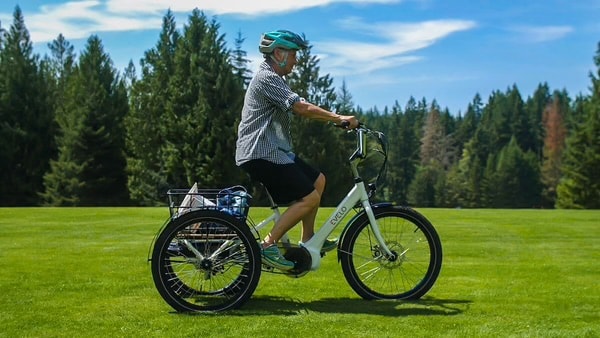
Here's the part that surprised me most. On a regular bike, you have to push hard enough to keep moving — and on a bad knee day, that can mean grinding through real pain just to get home. The electric assist on an e-trike lets you dial in exactly how much effort you want to put in. On a good day, I pedal and barely use the motor. On a stiff morning, I let the motor do 70% of the work and just keep my legs moving gently. Either way, I'm getting the joint movement and circulation benefits. The assist means you never have to push through pain to finish a ride.
The three-wheel difference for balance and confidence
A standard two-wheel bike requires constant micro-corrections to stay upright — your hips, core, and knees are all working to maintain balance even when you're not thinking about it. On a trike, that balancing act disappears. You can focus entirely on pedaling smoothly, which means better form, less compensatory tension in the surrounding muscles, and a more consistent range of motion through the knee. For anyone who's had a knee replacement or is recovering from surgery, the stability of three wheels is genuinely game-changing.
What I noticed after 90 days
I started riding two or three times a week, about 45 minutes each session. By the end of the first month, I was sleeping better — less nighttime aching. By month two, I'd cut my ibuprofen use in half. By month three, I was walking up stairs without bracing myself on the railing. I'm not a doctor and I can't promise you the same results. But I can tell you that the combination of consistent movement, zero impact, and the sheer joy of being outside did more for my knees than anything else I'd tried.
"Cycling reduces knee pain and stiffness in people with osteoarthritis — often more effectively than anti-inflammatory medication alone."
If you're on the fence about whether an e-trike is worth it for your joints, my honest advice is this: find a shop that lets you test ride one. Give it 20 minutes. Pay attention to how your knees feel during and after. I think you'll be surprised.
Keep reading
There's more where that came from — trail stories, gear guides, and honest talk about staying active at this age.